معرفی FlashMap؛ ابزار جدید برای سرعتبخشی به مدلهای زبانی بزرگ
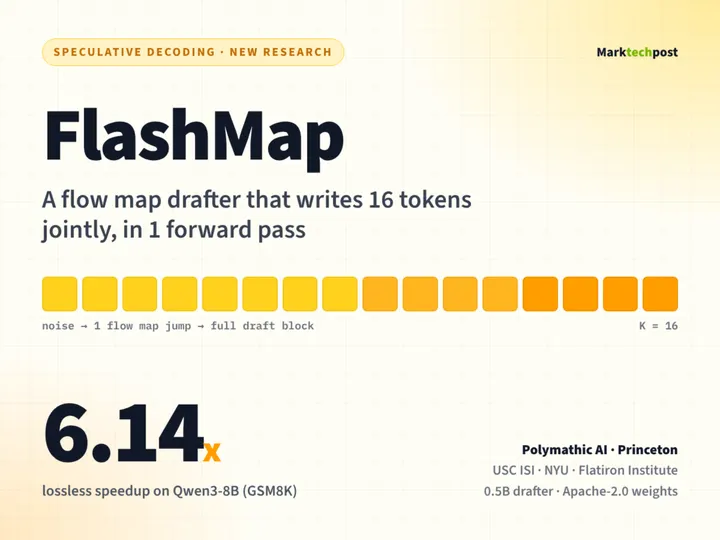
پژوهشگران Polymathic AI و دانشگاه پرینستون سیستم جدیدی به نام FlashMap را معرفی کردند که با استفاده از نقشههای جریان پیوسته، سرعت رمزگشایی مدلهای زبانی بزرگ را تا ۶.۱۴ برابر افزایش میدهد. این ابزار قادر است بلوکهای ۱۶ توکنی را به صورت همزمان تولید کند.
پژوهشگرانی از موسسات مختلف از جمله Polymathic AI، دانشگاه پرینستون و USC ISI از انتشار FlashMap خبر دادند. این فناوری یک رویکرد جدید در رمزگشایی گمانهزنی است که بلوکهای انتشار گسسته را با نقشههای جریان پیوسته جایگزین میکند. ابزار جدید میتواند یک بلوک کامل ۱۶ توکنی را در یک مرحله پردازش جلو (forward pass) پیشنویس کند، بهطوری که توکنهای درون بلوک با یکدیگر سازگار باقی بمانند.
این مدل سبکوزن حدود ۵۰۰ میلیون پارامتر دارد و بر روی مدل Qwen3-8B آزمایش شده است. نتایج نشان میدهد که FlashMap میتواند به سرعتبخشی تا ۶.۱۴ برابر بدون افت دقت در برخی بنچمارکها دست یابد. این سیستم نویز گاوسی را در یک مرحله به یک بلوک توکنی نگهداریشده تبدیل میکند و مدل هدف تمامی ۱۶ توکن را به صورت موازی بررسی میکند.
معماری این ابزار مبتنی بر یک ترانسفورماتور انتشار ۶ بلوکی است که وضعیتهای پنهان را از لایههای مختلف مدل هدف دریافت میکند. فرآیند آموزش این مدل شامل دو مرحله معلم جریان و دانشآموز نقشه جریان است. این بسته نرمافزاری با کتابخانههای پایتون سازگار است و پلاگینهای آن برای موتورهای سرویسدهی vLLM و SGLang ارائه شده است.
Polymathic AI and Princeton Researchers Release FlashMap, a Flow Map Drafter for 6.14x Faster LLM Decoding
FlashMap is a speculative decoding drafter from Polymathic AI, Princeton and USC ISI researchers. It drafts 16 tokens jointly in one pass and reaches up to 6.14x lossless speedup on Qwen3-8B.
Researchers from Polymathic AI, Princeton University, USC ISI, NYU and the Flatiron Institute have released FlashMap. FlashMap speculative decoding replaces the discrete diffusion drafter with a continuous flow map. It drafts a full 16-token block in 1 forward pass. Tokens in that block stay consistent with each other. On Qwen3-8B, the research team reports up to 6.14x lossless speedup on GSM8K. Drafter weights for Qwen3-8B and Qwen3-4B are on Hugging Face, with vLLM and SGLang plugins.
TL;DR
- Size: 0.5B-parameter drafter (500M for Qwen3-8B, 475M for Qwen3-4B); drafts blocks of K = 16 tokens.
- Runs on: the same GPU as the target model. Paper speedups use 1 NVIDIA H200 NVL at concurrency 1, in bf16.
- Performance: fastest drafter tested on Qwen3-8B, about 7% above a retrained DFlash on average.
- Best: 6.14x speedup on GSM8K at temperature 0 (acceptance length 7.69 tokens).
- Worst: 2.28x speedup on Alpaca at temperature 1. On Qwen3-4B (temperature 0), it trails DFlash on 4 of 9 tasks.
What is FlashMap?
FlashMap is a speculative decoding drafter that maps Gaussian noise to a token block in 1 step. A small drafter proposes K tokens. The target model then checks all K in 1 parallel pass and keeps the longest matching prefix. Output stays exactly what the target would produce.
Speed depends on 2 things. How many drafted tokens get accepted, and how cheaply they were drafted. EAGLE-3 drafts autoregressively, so cost grows with block length. DFlash drafts the full block in 1 pass with block diffusion.
Why do diffusion drafters lose acceptance?
DFlash predicts each slot in the block independently. The research team calls this the factorized approximation. Picture a continuation that is “new york” or “san diego” with equal odds. An independent drafter proposes “new diego” or “san york” half the time. The target rejects those at slot 2.
FlashMap builds on Flow Map Language Models. Each noise sample maps to 1 full block. The noise picks the mode for every slot jointly.
How does FlashMap work?
The drafter is a 6-block diffusion transformer (DiT), with embedding dimension 2048 and 16 attention heads. It reads hidden states from target layers 1, 9, 17, 25 and 33. Embedding matrix and LM head are copied from the target and stay frozen.
Training runs in 2 stages:
- Flow teacher: a continuous flow over one-hot token blocks, trained with cross-entropy. A time reparameterization handles Qwen3’s 151,936-token vocabulary.
- Flow map student: semigroup distillation turns the flow into a 2-time denoiser. It jumps from noise to data in 1 step.
Both drafters train on 500K samples from Open-PerfectBlend. Total compute across all models and ablations was about 4,600 GPU hours on H200s.
How does FlashMap compare on benchmarks?
The research team retrained EAGLE-3 and DFlash on the same data and settings. Tests cover 9 benchmarks across math, code and chat, at temperatures 0 and 1.
- Speed: 1-step FlashMap is the fastest drafter on every Qwen3-8B task, at both temperatures.
- Accuracy: 1-step FlashMap beats DFlash on acceptance length in 15 of 18 settings. It has about half the parameters.
- Chat gains are largest: at temperature 0, gains over DFlash are 5.5% on math, 11.1% on chat.
- 2-step mode: acceptance length beats DFlash in 18 of 18 settings, by 10% on average.
- EAGLE-3: at temperature 1, it has 9% higher acceptance length but runs 35% slower.
A shuffle test checks whether drafts use real inter-token structure. At 2 steps, FlashMap recovers most of the joint-structure gain of a 16-step teacher. At 1 step, it keeps only a small fraction. Drafting 4 noise samples as a tree raised speedup by 11% on average.
Comparison: FlashMap vs other speculative decoding drafters
Average speedups are computed by Marktechpost from Figure 1(c) of the FlashMap paper. Matched rows use the authors’ retrained baselines.
How do you deploy FlashMap?
The flashmap package needs only torch and transformers>=4.56. Install it with uv pip install flashmap. A spec_generate call runs drafter and target together on 1 GPU.
For serving, the project page gives 2 paths:
- vLLM 0.31: pass the drafter in --speculative-config with num_speculative_tokens set to 16.
- SGLang 0.5.20: use --speculative-algorithm DSPARK with the FlashMap draft path.
Set num_steps=2 to trade some speed for higher acceptance. For sampling above temperature 0, vLLM needs "draft_sample_method": "probabilistic".
Key Takeaways
- FlashMap drafts 16 tokens jointly in 1 pass with a continuous flow map.
- Up to 6.14x lossless speedup on Qwen3-8B, using a 0.5B drafter.
- Faster than a retrained DFlash on all 9 Qwen3-8B benchmarks.
- 2-step mode keeps acceptance flat across the block.
- Weights are Apache-2.0, code is MIT, with vLLM and SGLang plugins.
Check out the paper, project page, GitHub repo and model weights. Also, feel free to follow us on Twitter and don’t forget to join our 150k+ML SubReddit and Subscribe to our Newsletter. Wait! are you on telegram? now you can join us on telegram as well.
Need to partner with us for promoting your GitHub Repo OR Hugging Face Page OR Product Release OR Webinar etc.? Connect with us
Asif Razzaq is the CEO of Marktechpost AI Media Inc.. As a visionary entrepreneur and engineer, Asif is committed to harnessing the potential of Artificial Intelligence for social good. His most recent endeavor is the launch of an Artificial Intelligence Media Platform, Marktechpost, which stands out for its in-depth coverage of machine learning and deep learning news that is both technically sound and easily understandable by a wide audience. The platform boasts of over 2 million monthly views, illustrating its popularity among audiences.
Source report: MarkTechPost.
گزارش فارسی این خبر با کمک هوش مصنوعی و فقط بر اساس اطلاعات منتشرشده در منبع تهیه شده است.